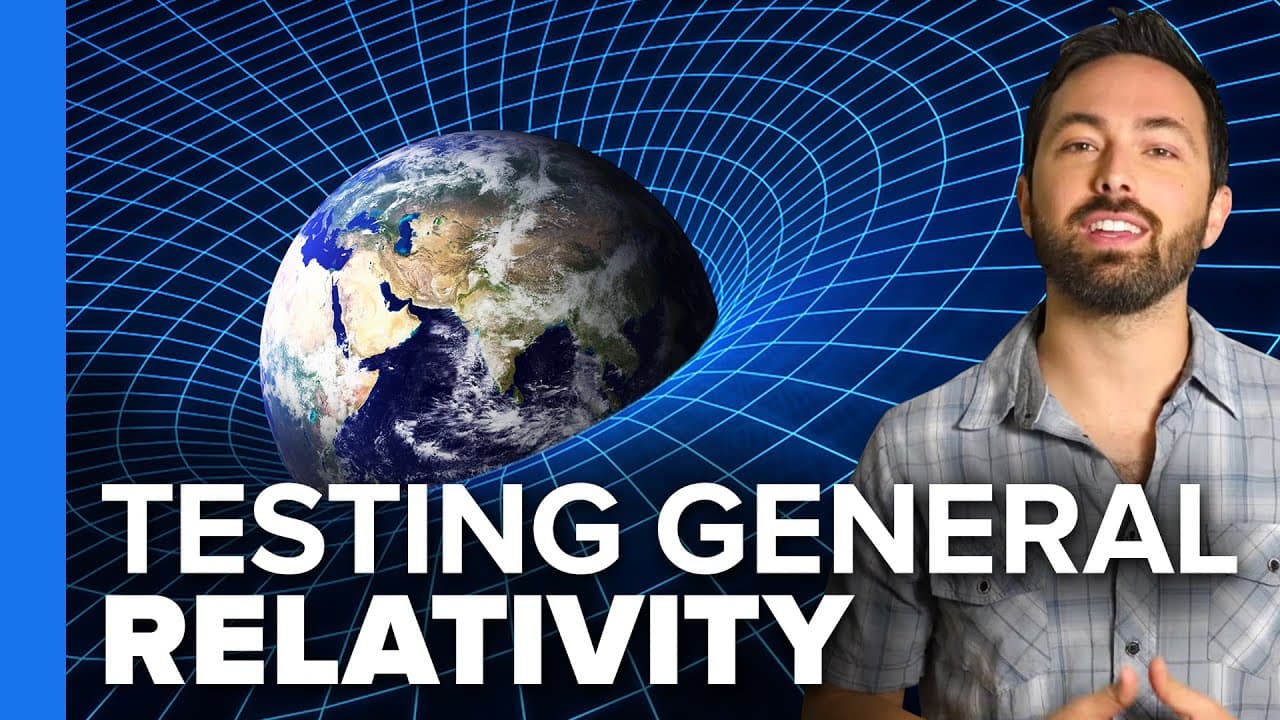
The Best Test of General Relativity (by 2 Misplaced Satellites)
TL;DR
Satellites launched by the European Space Agency were sent into the wrong orbit, but were used to test general relativity.
Transcript
Okay... Hello. Hey. So, this is good, this is good. You - you're working, can you see me? I can see you. Do you know what went wrong in-uh.. during the launch..? Yes - it's not complicated, but, it's a long chain of events.. On august, 21., 2014, two satellites were launched by the European Space Agency. They're called Galileo Satellites 5 and 6. T... Read More
Key Insights
- 🇪🇺 Satellites were launched by the European Space Agency to become part of the European GPS system.
- 🛰️ A thermal breach during the launch caused the satellites to be injected into incorrect elliptical orbits.
- 🛰️ The satellites were used to test the gravitational redshift predictions of general relativity.
- ⏲️ The primary clock on the satellites is a passive hydrogen MASER clock, which measures time with incredible stability.
- 🛰️ The impact of sunlight on the satellites was a significant source of error in the measurements.
- 🥳 Data was collected over a thousand days to improve statistics and reduce uncertainties.
- 🏆 The results of the tests confirmed the predictions of general relativity with a reduced uncertainty compared to previous measurements.
Install to Summarize YouTube Videos and Get Transcripts
Explore YouTube Video Summarizer or Get YouTube Transcript Extractor
Questions & Answers
Q: What went wrong during the launch of the satellites?
There was a thermal breach between a line of cold helium and propellant, causing the propellant to freeze and leading to a failure in altitude control.
Q: How were the satellites used to test general relativity?
The satellites had propellant on board which was used to attempt to correct their orbits. Their elliptical orbits allowed for a large change in gravitational potential, which could be measured to test general relativity.
Q: What is the primary clock used on the satellites?
The primary clock is a passive hydrogen MASER clock, which uses microwaves and the interaction of hydrogen atoms to measure time with incredible stability.
Q: Why was the measurement of the gravitational redshift difficult?
The biggest source of error was the impact of sunlight on the satellites, causing momentum and affecting the measurements. However, careful modeling and laser ranging helped reduce this uncertainty.
Summary & Key Takeaways
-
In 2014, two satellites were launched by the European Space Agency to become part of the European GPS system.
-
However, a thermal breach caused the satellites to be injected into incorrect elliptical orbits.
-
Scientists were able to use the satellites to test the gravitational redshift predictions of general relativity.
Read in Other Languages (beta)
Share This Summary 📚
Summarize YouTube Videos and Get Video Transcripts with 1-Click
Try YouTube Summary with ChatGPT & Claude or YouTube Transcript Generator
Explore More Summaries from Veritasium 📚



Summarize YouTube Videos and Get Video Transcripts with 1-Click
Try YouTube Summary with ChatGPT & Claude or YouTube Transcript Generator