Parallel Worlds Probably Exist. Here’s Why
TL;DR
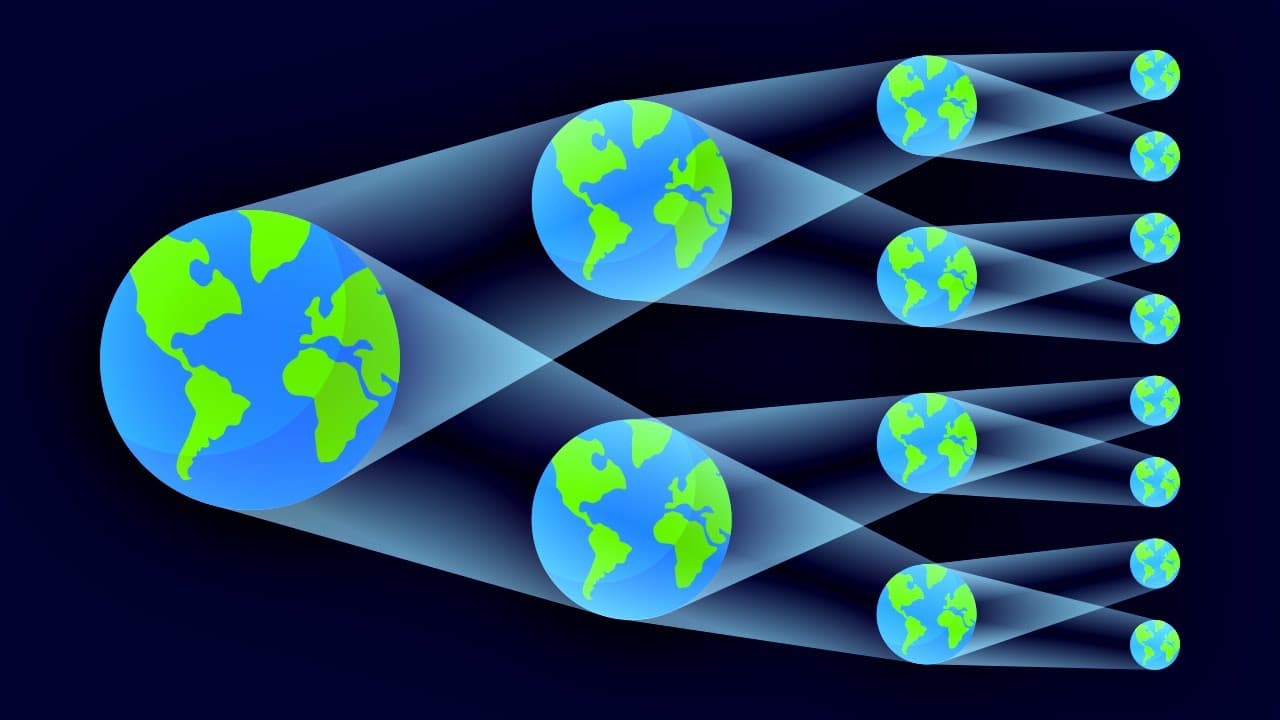
In quantum mechanics, the wavefunction of a particle can exist in a superposition of states, and the Many-Worlds Interpretation suggests that every possible outcome of an event exists in a separate parallel universe.
Transcript
a portion of this video was sponsored by Norton 360 classical mechanics is great if you know the state of a system say the position and velocity of a particle then you can use an equation Newton's second law to calculate what that particle will do in the future in quantum mechanics if you know the quantum state of a particle that is its wave functi... Read More
Key Insights
- 🦾 Classical mechanics uses deterministic equations, while quantum mechanics relies on wave functions and probabilities.
- 🦾 The Born rule introduced the idea of probability into quantum mechanics.
- ❓ The Many-Worlds Interpretation suggests that every possible outcome of an event creates separate parallel universes.
- 😺 Schrodinger's cat experiment questions the interpretation of quantum mechanics.
- 🦾 Superposition and entanglement are fundamental concepts in quantum mechanics.
- 👋 Measurement and observation collapse the wave function, revealing a specific outcome.
- 👋 Many-Worlds Interpretation offers a logical and consistent explanation of quantum mechanics, where wave functions and branching universes are the complete picture of reality.
Install to Summarize YouTube Videos and Get Transcripts
Explore YouTube Video Summarizer or Get YouTube Transcript Extractor
Questions & Answers
Q: How does classical mechanics differ from quantum mechanics in predicting future behavior?
In classical mechanics, equations can determine the future behavior of a system based on known initial conditions. In quantum mechanics, probabilities are calculated based on the wave function, which describes the probability distribution of finding a particle at different positions.
Q: What is the Born rule and how does it relate to the wave function?
The Born rule states that by squaring the amplitude of the wave function, you can calculate the probability of finding a particle at a specific point. It introduced the concept of probability into the core of quantum mechanics.
Q: What is the Many-Worlds Interpretation in quantum mechanics?
The Many-Worlds Interpretation suggests that with every possible outcome of an event, the universe splits into separate branches, each representing a different outcome. This means that every possible outcome actually happens in separate parallel universes.
Q: How does Schrodinger's cat experiment challenge the interpretation of quantum mechanics?
Schrodinger's cat experiment highlights the strange superposition of quantum states, where a cat inside a box can be both dead and alive until the box is opened. It questions how a macroscopic object can be in such a superposition.
Summary & Key Takeaways
-
Classical mechanics uses equations to predict future behavior based on initial conditions, while quantum mechanics calculates probabilities based on the wave function of a particle.
-
The wave function describes the probability distribution of finding a particle at different positions, and the Born rule states that squaring the amplitude of the wave function gives the probability of finding the particle at a specific point.
-
Schrodinger's cat experiment was designed to challenge the interpretation of quantum mechanics, but the Many-Worlds Interpretation suggests that the universe splits into separate branches with every possible outcome of an event.
Read in Other Languages (beta)
Share This Summary 📚
Summarize YouTube Videos and Get Video Transcripts with 1-Click
Try YouTube Summary with ChatGPT & Claude or YouTube Transcript Generator
Explore More Summaries from Veritasium 📚


Summarize YouTube Videos and Get Video Transcripts with 1-Click
Try YouTube Summary with ChatGPT & Claude or YouTube Transcript Generator