3 Perplexing Physics Problems
TL;DR
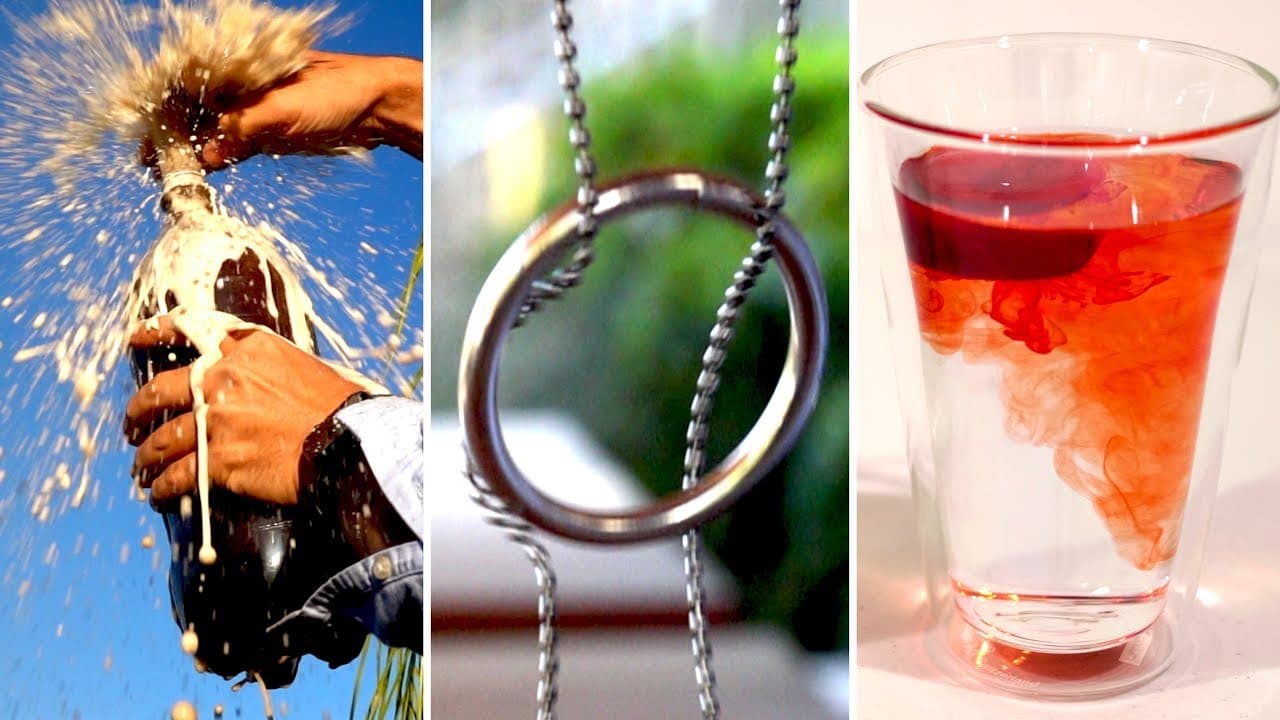
This video tackles three physics problems: why shaken carbonated drinks explode, why ice cubes in fresh water melt faster than in salt water, and how a ring can stick to a closed loop of a chain.
Transcript
everyone knows if you shake up a carbonated drink it explodes but why is this well here I have an identical bottle with a pressure gauge fitted to it and I want you to make a prediction right here if I shake up this bottle will the pressure increase decrease or remain the same and while you're thinking about that let me tell you this video is spons... Read More
Key Insights
- 🤝 Shaking a carbonated drink doesn't increase the pressure inside; instead, it introduces nucleation sites for CO2 to come out of solution.
- 🧊 Ice cubes melt faster in fresh water because the cold water descends, bringing warmer water to the ice cube, while in salt water, the cold water remains around the ice cube, insulating it.
- 🛝 A ring can stick to a closed loop of a chain by introducing rotation before dropping it, causing it to slide down while pieces slide up the sides.
- 🍓 Paper straws may create more nucleation sites than plastic straws, making carbonated drinks fizzier.
- 👤 Squarespace is a user-friendly platform for building websites, online stores, and portfolios.
- 💌 Squarespace offers features like analytics, e-commerce capabilities, email campaigns, and 24/7 customer support.
- 🥶 Squarespace allows for domain purchases with free Whois privacy, and website changes can be made without the need for a web developer.
Install to Summarize YouTube Videos and Get Transcripts
Explore YouTube Video Summarizer or Get YouTube Transcript Extractor
Questions & Answers
Q: Why doesn't shaking a carbonated drink increase the pressure inside the bottle?
Shaking a carbonated drink introduces tiny air bubbles into the liquid, which act as nucleation sites for CO2 to come out of solution. This doesn't increase the pressure but allows for a rapid release of CO2 when the bottle is opened.
Q: Why do ice cubes melt faster in fresh water than in salt water?
When ice cubes melt in fresh water, the cold water descends, bringing warmer fresh water to the ice cube, melting it faster. In salt water, the cold water remains around the ice cube, insulating it from the warmer water.
Q: How does a ring stick to a closed loop of a chain?
By introducing a slight rotation before dropping the ring onto the chain, it rotates about 90 degrees and slides down, with pieces sliding up the sides. The final piece at the bottom gets pulled around and locks the ring onto the chain.
Q: Why do Mentos cause a carbonated drink to explode?
Mentos have a rough surface that acts as a nucleation site, providing more opportunities for CO2 to come out of solution rapidly, creating a soda fountain effect.
Summary & Key Takeaways
-
Shaking a carbonated drink does not increase the pressure inside the bottle; instead, shaking introduces tiny air bubbles into the liquid, which act as nucleation sites for the dissolved CO2 to come out of solution, leading to an explosion.
-
Ice cubes in fresh water melt faster than in salt water because the cold water released from the melting ice cube in fresh water descends and brings more warm fresh water, while in salt water, the cold water stays around the ice cube, insulating it from the warmer water.
-
A ring can stick to a closed loop of a chain by introducing a slight rotation before dropping it, causing the ring to rotate about 90 degrees and slide down the chain. This locks the ring onto the chain.
Read in Other Languages (beta)
Share This Summary 📚
Summarize YouTube Videos and Get Video Transcripts with 1-Click
Try YouTube Summary with ChatGPT & Claude or YouTube Transcript Generator
Explore More Summaries from Veritasium 📚





Summarize YouTube Videos and Get Video Transcripts with 1-Click
Try YouTube Summary with ChatGPT & Claude or YouTube Transcript Generator